You can't arrest the awakening, you cannot suppress the advancement of consciousness...
Artist - Unknown
Watch/Read 285 FREE Creature Effects Blogs and Videos —>>http://bit.ly/1iWZGxQ
Image - “Alien” (1979) concept art drawn by creature creator Carlo Rambaldi.
Special thanks to Dimitar Dimitrov for sharing it first.
Why is Facebook blue? According to The New Yorker, the reason is simple. It’s because Mark Zuckerberg is red-green color blind; blue is the color Mark can see the best.
Not highly scientific, right? That may not be the case for Facebook,
but there are some amazing examples of how colors actually affect our
purchasing decisions. After all, sight is the strongest developed sense
in most human beings. It’s only natural that 90% of an assessment for
trying out a product is made by color alone.
So how do colors really affect us, and what is the science of colors
in marketing, really? As we strive to make improvements to our product
at Buffer, studying this phenomenon is key. Let’s dig into some of the latest, most interesting research on it. First: Can you recognize the online brands just based on color?
Before we dive into the research, here are some awesome experiments
that show you how powerful color alone really is. Based on just the
colors of the buttons, can you guess which company belongs to each of
them? Example 1 (easy): Example 2 (easy): Example 3 (medium): Example 4 (hard):
These awesome examples from YouTube designer Marc Hemeon, I think, show the real power of color more than any study could.
How many were you able to guess? (All the answers are at the bottom of this post!) Which colors trigger which feeling for us?
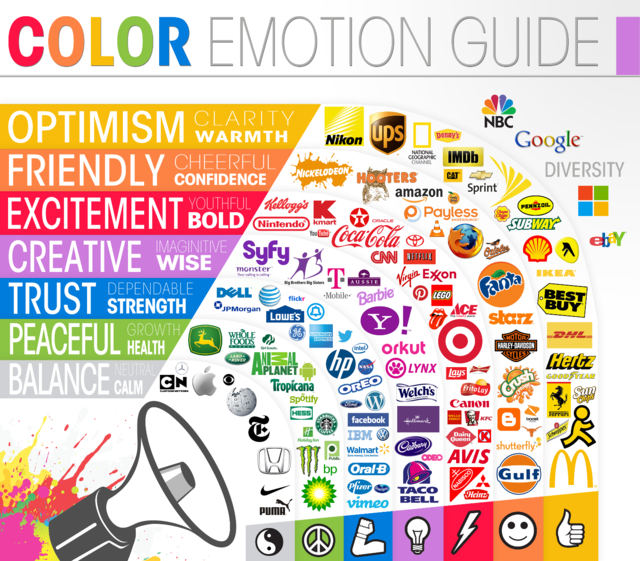
Being completely conscious about what color triggers us to think in which way isn’t always obvious. The Logo Company has come up with an amazing breakdown that shows which colors are best for which companies and why. Here are 4 great examples: Black: Green: Blue:
Clearly, every one of these companies is seeking to trigger a very specific emotion:
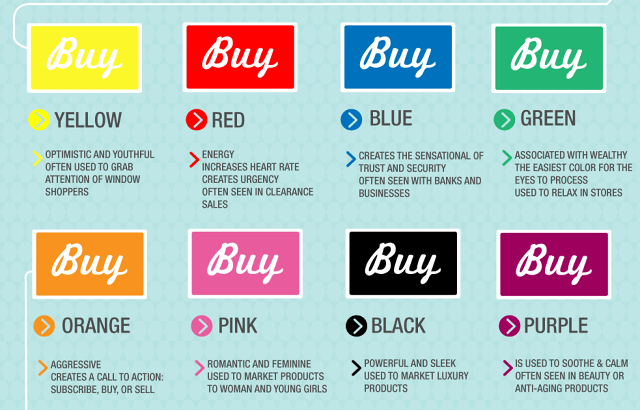
When we feel compelled to buy something, color can play a major role. Analytics company KISSmetrics created an amazing infographic on the science of how colors affect our purchases.
Green stands out to me as the most relaxing color we can use to make
buying easier. We didn’t intentionally choose this as the main color for
Buffer--although it seems to have worked very well so far.
At second look, I also realized how frequently black is used for luxury products. Here is the full infographic: How to improve your marketing with better use of colors:
This all might be fairly entertaining, but what are some actual decisions we can apply today to our website or app? The answer comes yet again from some great research done by the good folks over at KISSmetrics.
If you are building an app that mainly targets women, KISSmetrics
suggests that women love blue, purple, and green, and dislike orange,
brown, and gray.
In case your app is strictly targeting men, the rules of the game are
slightly different. Men love blue, green, and black, but can do without
brown, orange, and purple.
In another experiment, Performable (now HubSpot) wanted to find out whether simply changing the color of a button would make a difference in conversion rates.
They started out by trying to guess the outcome of a simple choice
between two colors (green and red) and trying to guess what would
happen.
“Green connotes ideas like “natural” and “environment,” and given its
wide use in traffic lights, suggests the idea of “go” or forward
movement. The color red, on the other hand, is often thought to
communicate excitement, passion, blood, and warning. It is also used as
the color for stopping at traffic lights. Red is also known to be
eye-catching.”
So, clearly an A/B test between green and red would result in green,
the more friendly color. At least that was their guess. Here is what
their experiment looked like:
So how did that experiment turn out? The answer was surprising: The red button outperformed the green button by 21%.
What’s most important to consider is that nothing else was changed at
all: 21% more people clicked on the red button than on the green
button. Everything else on the pages was the same, so it was only the
button color that made this difference.
This definitely made me wonder: If we were to read all the research
before this experiment and ask every researcher which version they would
guess would perform better, I’m sure green would be the answer in
nearly all cases. Not so much.
At my company, we’ve also conducted dozens of experiments to improve our conversion rates using changes of colors.
While the results weren’t as clear, we still saw a huge change. One
hypothesis is that for a social media sharing tool, there is less of a
barrier to signup, which makes the differences less significant.
Despite all the studies, generalizations are extremely hard to make.
Whatever change you make, treat it first as a hypothesis, and see if the
actual experiment supports your ideas. Personally, I’m always very
prone to go with opinion based on research I’ve come across. Yet, data
always beats opinion, no matter what. Quick last fact: Why are hyperlinks blue?
This is something that always interested me and is actually a fun story. In short, it's offers the highest contrast between the colors used on early websites.
Here is the full explanation: “Tim Berners-Lee, the main inventor of
the web, is believed to be the man who first made hyperlinks blue.
Mosaic, a very early web browser, displayed webpages with a (ugly) gray
background and black text. The darkest color available at the time that
was not the same as the black text was that blue color. Therefore, to
make links stand apart from plain text, but still be readable, the color
blue was selected.”
I think it's fascinating that tweaking something as small as the
color can completely change an outcome. What have been your findings in
terms of colors and marketing? Tell me about it in the comments.
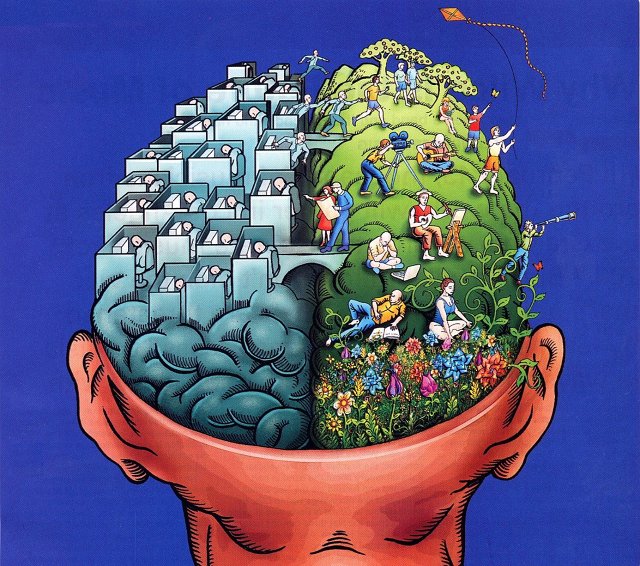
One of the things that surprises me time and time again is how we think our brains work and how they actually do.
On many occasions, I find myself convinced that there is a certain
way to do things, only to find out that actually that’s the completely
wrong way to think about it. For example, I always found it fairly
understandable that we can multitask. Well, according to the latest
research studies, it’s literally impossible for our brains to handle two
tasks at the same time.
Recently, I came across more of these fascinating experiments and
ideas that helped a ton to adjust my workflow towards how our brain
actually works (instead of how I thought it does).
So here are 10 of the most surprising things our brain does and what we can learn from this information. 1. Your brain does creative work better when you’re tired.
When I explored the science of our body clocks and how they affect
our daily routines, I was interested to find that a lot of the way I’d
planned my days wasn’t really the best way to go about it. The way we
work, in particular, actually has a lot to do with the cycles of our
body clocks.
Here’s how it breaks down:
If you’re a morning lark, say, you’ll want to favor those morning
hours when you’re feeling more fresh to get your most demanding,
analytical work done. Using your brain to solve problems, answer
questions and make decisions is best done when you’re at your peak.
For night owls, this is obviously a much later period in the day.
On the other hand, if you’re trying to do creative work,
you’ll actually have more luck when you’re more tired and your brain
isn’t functioning as efficiently. This sounds crazy, but it
actually makes sense when you look at the reasoning behind it. It’s one
of the reasons why great ideas often happen in the shower after a long day of work.
If you’re tired, your brain is not as good at filtering out
distractions and focusing on a particular task. It’s also a lot less
efficient at remembering connections between ideas or concepts. These
are both good things when it comes to creative work, since this kind of
work requires us to make new connections, be open to new ideas, and
think in new ways. So a tired, fuzzy brain is of much more use to us
when working on creative projects.
This Scientific Americanarticle explains how distractions can actually be a good thing for creative thinking:
Insight problems involve thinking outside the box. This
is where susceptibility to “distraction” can be of benefit. At off-peak
times we are less focused, and may consider a broader range of
information. This wider scope gives us access to more alternatives and
diverse interpretations, thus fostering innovation and insight.
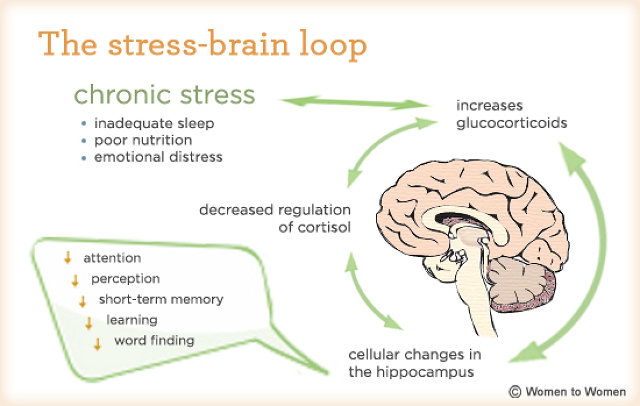
2. Stress can change the size of your brain (and make it smaller).
I bet you didn’t know stress is actually the most common cause of
changes in brain function. I was surprised to learn this when I looked
into how stress affects our brains.
I also found some research that showed signs of brain size decreasing due to stress.
One study used baby monkeys to test the effects of stress on development and long-term mental health. Half the monkeys were cared for by their peers for six months, while the other half remained with their mothers. Afterwards, the monkeys were returned to typical social groups for several months before the researchers scanned their brains. For the monkeys who had been removed from their mothers and
cared for by their peers, areas of their brains related to stress were
still enlarged, even after being in normal social conditions for several months.
Although more studies are needed to explore this fully, it’s pretty
scary to think that prolonged stress could affect our brains long term.
Another study found that in rats who were exposed to chronic stress, the hippocampuses in their brains actually shrank.
The hippocampus is integral to forming memories. It has been debated
before whether Post-traumatic Stress Disorder (PTSD) can actually shrink
the hippocampus, or people with naturally smaller hippocampuses are
just more prone to PTSD. This study could point to the stress being a
factor in actually changing the brain. 3. It is literally impossible for our brains to multitask.
Multitasking is something we’ve long been encouraged to practice, but it turns out multitasking is actually impossible.
When we think we’re multitasking, we’re actually context-switching.
That is, we’re quickly switching back and forth between different tasks,
rather than doing them at the same time.
The book Brain Rules explains how detrimental “multitasking” can be:
Research shows your error rate goes up 50%, and it takes you twice as long to do things.
The problem with multitasking is that we’re splitting our brain’s resources. We’re giving less attention to each task and probably performing worse on all of them:
When the brain tries to do two things at once, it divides and conquers, dedicating one-half of our gray matter to each task.
Here is how this looks in reality. While we try to do both Action A
and Action B at the same time, our brain is never handling both
simultaneously. Instead, it has to painfully switch back and forth and
use important brainpower just to switch:
When our brains handle a single task, the prefrontal cortex plays a big part. Here’s how it helps us achieve a goal or complete a task:
The anterior part of this brain region forms the goal or
intention--for example, “I want that cookie”--and the posterior
prefrontal cortex talks to the rest of the brain so that your hand
reaches toward the cookie jar, and your mind knows whether you have the
cookie.
A study in Paris
found that when a second task was required, the brains of the study
volunteers split up, with each hemisphere working alone on a task. The
brain was overloaded by the second task and couldn’t perform at its full
capacity, because it needed to split its resources.
When a third task was added, the volunteers’ results plummeted:
The triple-task jugglers consistently forgot one of their
tasks. They also made three times as many errors as they did while
dual-tasking.
4. Naps improve your brain’s day-to-day performance.
We’re pretty clear on how important sleep is for our brains, but what about naps? It turns out, these short bursts of sleep are actually really useful.
Here are a couple of ways napping can benefit the brain. Improved memory In one study,
participants memorized illustrated cards to test their memory strength.
After memorizing a set of cards, they had a 40-minute break wherein one
group napped and the other stayed awake. After the break, both groups
were tested on their memory of the cards, and the group that had napped
performed better:
Much to the surprise of the researchers, the sleep group
performed significantly better, retaining on average 85% of the
patterns, compared to 60% for those who had remained awake.
Research indicates that when a memory is first recorded
in the brain--in the hippocampus, to be specific--it’s still “fragile”
and easily forgotten, especially if the brain is asked to memorize more
things. Napping, it seems, pushes memories to the neocortex, the brain’s
“more permanent storage,” preventing them from being “overwritten.”
Let’s look at that in a graph--the people who took a nap, were able
to wildly outperform those who didn’t. It’s as though they had a fresh
start: Better learning
Taking a nap also helps to clear information out of your brain’s
temporary storage areas, getting it ready for new information to be
absorbed. A study from the University of California asked participants
to complete a challenging task around midday, which required them to
take in a lot of new information. At around 2 p.m., half of the
volunteers took a nap while the rest stayed awake.
The really interesting part of this study is not only that at 6 p.m.
that night the napping group performed better than those who didn’t take
a nap. In fact, the napping group actually performed better than they
had earlier in the morning. What happens in the brain during a nap
Some recent research has
found that the right side of the brain is far more active during a nap
than the left side, which stays fairly quiet while we’re asleep. Despite
the fact that 95% of the population is right-handed, with the left side
of their brains being the most dominant, the right side is consistently
the more active hemisphere during sleep.
The study’s author, Andrei Medvedev, speculated that the right side of the brain handles ‘housekeeping’ duties while we’re asleep.
So while the left side of your brain takes some time off to relax,
the right side is clearing out your temporary storage areas, pushing
information into long-term storage and solidifying your memories from
the day. 5. Your vision trumps all other senses.
Despite being one of our five main senses, vision seems to take precedence over the others:
Hear a piece of information, and three days later you’ll remember 10% of it. Add a picture and you’ll remember 65%.
Pictures beat text as well, in part because reading is so
inefficient for us. Our brain sees words as lots of tiny pictures, and
we have to identify certain features in the letters to be able to read
them. That takes time.
In fact, vision is so powerful that the best wine tasters in the world have been known to describe a dyed white wine as a red.
Not only is it surprising that we rely on our vision so much, but it actually isn’t even that good. Take this fact, for instance:
Our brain is doing all this guessing because it doesn’t know where things are.
In a three-dimensional world, the light actually falls on our retina in
a two-dimensional fashion. So our brain approximates viewable image.
Let’s look at this image. It shows you how much of your brain is
dedicated just to vision and how it affects other parts of the brain.
It’s a truly staggering amount, compared to any other areas: 6. Introversion and extroversion come from different wiring in the brain.
I just recently realized that introversion and extroversion are not actually related to how outgoing or shy we are, but rather how our brains recharge.
Here’s how the brains of introverts and extroverts differ:
Research has actually found that there is a difference in the brains of extroverted and introverted people in
terms of how we process rewards and how our genetic makeup differs. For
extroverts, their brains respond more strongly when a gamble pays off.
Part of this is simply genetic, but it’s partly the difference of their dopamine systems as well. An experiment that had people take gambles while in a brain scanner found the following:
When the gambles they took paid off, the more extroverted
group showed a stronger response in two crucial brain regions: the
amygdala and the nucleus accumbens.
The nucleus accumbens is part of the dopamine system, which affects
how we learn and is generally known for motivating us to search for
rewards. The difference in the dopamine system in the extrovert’s brain
tends to push them towards seeking out novelty, taking risks and
enjoying unfamiliar or surprising situations more than others. The
amygdala is responsible for processing emotional stimuli, which gives
extroverts that rush of excitement when they try something highly
stimulating, which might overwhelm an introvert. More research
has actually shown that the difference comes from how introverts and
extroverts process stimuli. That is, the stimulation coming into our
brains is processed differently, depending on your personality. For
extroverts, the pathway is much shorter. It runs through an area where
taste, touch, visual, and auditory sensory processing takes place. For
introverts, stimuli runs through a long, complicated pathway in areas of
the brain associated with remembering, planning, and solving problems. 7. We tend to like people who make mistakes more.
Apparently, making mistakes actually makes us more likable, due to something called the Pratfall Effect.
Kevan Lee recently explained how this works on the Buffer blog:
Those who never make mistakes are perceived as less
likable than those who commit the occasional faux pas. Messing up draws
people closer to you, makes you more human. Perfection creates distance
and an unattractive air of invincibility. Those of us with flaws win
every time.
This theory was tested by psychologist Elliot Aronson. In his
test, he asked participants to listen to recordings of people answering a
quiz. Select recordings included the sound of the person knocking over a
cup of coffee. When participants were asked to rate the quizzers on
likability, the coffee-spill group came out on top.
So this is why we tend to dislike people who seem perfect. And now we
know that making minor mistakes isn’t the worst thing in the world--in
fact, it can work in our favor. 8. Meditation can rewire your brain for the better.
Here’s another one that really surprised me. I thought meditation was
only good for improving focus and helping me stay calm throughout the
day, but it actually has a whole bunch of great benefits.
Here are a few examples. Less anxiety
This point is pretty technical, but it’s really interesting. The more
we meditate, the less anxiety we have, and it turns out this is because
we’re actually loosening the connections of particular neural pathways. This sounds bad, but it’s not.
What happens without meditation is that there’s a section of our
brains that’s sometimes called the Me Center (it’s technically the
medial prefrontal cortex). This is the part that processes information
relating to ourselves and our experiences. Normally the neural pathways
from the bodily sensation and fear centers of the brain to the Me Center
are really strong. When you experience a scary or upsetting sensation,
it triggers a strong reaction in your Me Center, making you feel scared
and under attack.
Here is how anxiety and agitation decreases with just a 20-minute meditation session:
When we meditate, especially when we are just getting started with meditation,
we weaken this neural connection. This means that we don’t react as
strongly to sensations that might have once lit up our Me Centers. As we
weaken this connection, we simultaneously strengthen the connection
between what’s known as our Assessment Center (the part of our brains
known for reasoning) and our bodily sensation and fear centers. So when
we experience scary or upsetting sensations, we can more easily look at
them rationally. Here’s a good example:
For example, when you experience pain, rather than
becoming anxious and assuming it means something is wrong with you, you
can watch the pain rise and fall without becoming ensnared in a story
about what it might mean.
More creativity Researchers at Leiden University in the Netherlands
studied both focused-attention and open-monitoring meditation to see if
there was any improvement in creativity afterwards. They found that
people who practiced focused-attention meditation did not show any
obvious signs of improvement in the creativity task
following their meditation. For those who did open-monitoring
meditation, however, they performed better on a task that asked them to
come up with new ideas. Better memory
One of the things meditation has been linked to is improving rapid memory recall. Catherine Kerr,
a researcher at the Martinos Center for Biomedical Imaging and the
Osher Research Center found that people who practiced mindful meditation
were able to adjust the brain wave that screens out distractions and increase their productivity
more quickly that those who did not meditate. She said that this
ability to ignore distractions could explain “their superior ability to
rapidly remember and incorporate new facts.” This seems to be very
similar to the power of being exposed to new situations that will also dramatically improve our memory of things.
Meditation has also been linked
to increasing compassion, decreasing stress, improving memory skills,
and even increasing the amount of gray matter in the brain. 9. Exercise can reorganize the brain and boost your willpower.
Sure, exercise is good for your body, but what about your brain? Well apparently there’s a link between exercise and mental alertness, in a similar way that happiness and exercise are related.
A lifetime of exercise can result in a sometimes
astonishing elevation in cognitive performance, compared with those who
are sedentary. Exercisers outperform couch potatoes in tests that
measure long-term memory, reasoning, attention, problem-solving, even
so-called fluid-intelligence tasks.
Of course, exercise can also make us happier, as we’ve explored before:
If you start exercising,
your brain recognizes this as a moment of stress. As your heart
pressure increases, the brain thinks you are either fighting the enemy
or fleeing from it. To protect yourself and your brain from stress, you
release a protein called BDNF
(Brain-Derived Neurotrophic Factor). BDNF has a protective and also
reparative element to your memory neurons and acts as a reset switch.
That’s why, after exercising, we often feel so at ease, things are
clear, and eventually we're happy.
At the same time, endorphins, which also fight stress, are released in your brain. The main purpose of endorphins is this, writes researcher McGovern:
These endorphins tend to minimize the discomfort of
exercise, block the feeling of pain, and are even associated with a
feeling of euphoria.
10. You can make your brain think time is going slowly by doing new things.
Ever wished you didn’t find yourself saying “Where does the time go!”
every June when you realize the year is half over? This is a neat trick
that relates to how our brains perceive time. Once you know how it
works, you can trick your brain into thinking time is moving more
slowly.
Essentially, our brains take a whole bunch of information from our
senses and organize it in a way that makes sense to us, before we ever
perceive it. So what we think is our sense of time is actually just a
whole bunch of information presented to us in a particular way, as determined by our brains:
When our brains receive new information, it doesn’t
necessarily come in the proper order. This information needs to be
reorganized and presented to us in a form we understand. When familiar
information is processed, this doesn’t take much time at all. New
information, however, is a bit slower and makes time feel elongated.
Even stranger, it isn’t just a single area of the brain that controls our time perception--it’s done by a whole bunch of brain areas, unlike our common five senses, which can each be pinpointed to a single, specific area.
When we receive lots of new information, it takes our brains a while to process it all. The longer this processing takes, the longer that period of time feels:
When we’re in life-threatening situations, for instance, “we remember
the time as longer because we record more of the experience.
Life-threatening experiences make us really pay attention, but we don’t
gain superhuman powers of perception.”
The same thing happens when we hear enjoyable music, because “greater attention leads to perception of a longer period of time.”
Conversely, if your brain doesn’t have to process lots of new information,
time seems to move faster, so the same amount of time will actually
feel shorter than it would otherwise. This happens when you take in lots
of information that’s familiar, because you’ve processed it before.
Your brain doesn’t have to work very hard, so it processes time faster.
Do you have another surprising fact about the brain you’d like to
share? I’d love to hear it! If you enjoyed this post, I think you might
also like our post about "10 Simple Things You Can Do Today That Will Make You Happier, Backed By Science."
Da Vinci’s belief that "everything connects" helped make him the
15th-century Italian Renaissance man we all admire today. And it was
another legendary thinker who noted that "the past is prologue." Connect
the dots to create a pretty picture for you and your business.
In recent years, Leonardo da Vinci has attracted a lot of fresh press with the popularity of Dan Brown's book, The Da Vinci Code. And now with a new TV series from David GoyerDa Vinci's Demons on Starz, Da Vinci’s stature is perhaps at an all-time high. The Boston Globe writes, "In the buoyant new historical
fantasy series 'Da Vinci’s Demons,' Leonardo da Vinci might as well be
the guy who invented the latest, greatest social media app. He’s a
technological geek with strong people skills and an ability to market
his concepts."
I got hooked into the series right from the very beginning. The
series shows how Da Vinci manifests the future with his ability to
repeatedly visualize and then architect his innovative future. It was Da
Vinci’s observation and belief that "everything connects" that made him
the 15th-century Italian Renaissance man that we all admire today.
I call this ability to connect "the CONVERGENCE"--bringing
art, science, and spirituality together. And making connections between
disparate things is perhaps the number one skill needed for creative
thinking.
The ritualistic practice of thinking about how different things
relate to each other, and how different things could be combined to make
something completely different results in sustainable innovation. And
it applies to our lives and professions equally, no matter what we do.
Author Harvey Mackay, in his blog Power of Visualization Helps You Achieve Goals
writes: “To have an idea or dream, and then to see how you can make it
happen, helps shape your plans and defines your goals more clearly.”
Mackay highlights that Nobel Laureate Jonas Salk was asked how he went
about inventing the polio vaccine. His reply? "I pictured myself as a
virus or a cancer cell and tried to sense what it would be like."
For the most part, my life (sure, it has been full of ups and downs
just like millions of other people’s) is an absolute result of how I
visualized my steps forward. Manifestation of a reality perhaps begins
with a vision, faith, and a certain amount of luck along the way.
But the ability to visualize the details of how disparate elements
connect with each other makes a significant difference. To visualize, it
requires us to be deeply "awake" along with having the how-to knowledge
for the implementation of our plan. People who succeed constantly
visualize and re-envision the steps of how to push forward regardless of
a situation.
Take a look at the following clip from Da Vinci’s Demons, where (even though it's a fantasy) the art and science of visualization is masterfully captured:
http://www.youtube.com/watch?feature=player_embedded&v=BMe1AXC4EFE#t=0
In the psychology community, creative visualization
refers to the practice of seeking to affect the outer world by changing
one's thoughts and expectations. It is practiced extensively in the
professional sports community.
Dr. William Fezler, in his book Creative Imagery: How to Visualize in All Five Senses
suggests creating a detailed schema of what one desires and then
visualizing it over and over again with all of the senses (i.e., what do
you see? what do you feel? what do you hear? what does it smell like?).
Visualization practices are also common in many Eastern spiritual
exercises. In Vajrayana Buddhism, complex visualizations are used to
attain nirvana. Hindu Monistic theory makes similar arguments as Dr.
Fezler. Robert Redford’s movie The Legend of Bagger Vance is full of Hindu mysticism of practicing mental visualization. The movie was based on the 1995 book of the same title by Steven Pressfield and is about a golfer in Georgia.
“See the place where the tides, and the seasons ... the
turning of the earth all come together; where everything that is becomes
one. You've got to seek that place, with your soul, Junuh. Seek it with
your hands, don't think about it, feel it. Your hands are wiser than
your head's ever gonna be. I can't take you there ... I just hope I can
help you find a way.” ~ Bagger Vance,
Successful people like Oprah Winfrey, Bill Gates (who is a big Da Vinci fan,
incidentally), and Will Smith all claim to practice visualization.
Actor Jim Carrey says that he wrote a check to himself in 1987 in the
sum of $10 million. He dated it "Thanksgiving 1995" and added the
notation: “for acting services rendered.” He visualized it for years and
in 1994 he received $10 million for his role in the movie Dumb and Dumber.
Okay, but most of us are neither sages nor celebrities, so how do we practice visualization?
As an entrepreneur, author, technologist, and a dreamer, I have
taught myself three basic things in the hopes of manifesting my own
future:
I imagine myself in the final stage (of my goals, my products, my companies, my personal life, etc.).
I study patterns (of my surroundings, my markets, my skills, my behaviors, my reactions, my skills, etc.).
I practice rituals (to be disciplined about my devotion, to recover from my defeats, to thrive, to achieve a higher degree of confidence, etc.).
Visualization is perhaps one of the many attributes that assures
one’s future. But I have come to believe it is certainly a critical
factor.
Da Vinci’s Demons is, of course, a television fantasy, but
it effectively portrays his thinking process. If you want to know the
real Da Vinci and all his ups and down, check out the following BBC
program: Leonardo da Vinci: The Man Who Wanted to Know Everything.
http://www.youtube.com/watch?v=Rog5i2n1QVs&feature=player_embedded#t=0
Tuesday, 24 December 2013
Even masquerade dey flex relax... If u like no enjoy ursef o...
Dis world no reach 2 abeg.
Merry Xmas and Happy new year in Advance.
This
stunning image is actually five women decorated by world champion
body-painter Johannes Stötter to look like an amphibian. Absolutely
amazing.
This picture has been all over my news feed this morning. Pretty amazing!
It's always there, always waiting, always within you...and it doesn't take a quiet day to listen.
Saturday, 21 December 2013
Device Which Charges Your Phone With The Heat In Your Coffee
A
mum’s first baby is always a momentous occasion - but the day of
Chelsea Johnson’s son’s birth was made even more memorable for a very
special reason.
For
not only was little Landon-Jonah Johnson born on December 11, 2013, he
also made a perfectly-timed entrance into the world at quarter past two
in the afternoon - making the time and date of birth 11/12/13 14:15.
Chelsea, aged 21, from Rawmarsh, Rotherham, said that her son was a ‘miracle’. “He’s a special little boy,” she said. “I can’t wait to tell him when he’s older about when he was born, and whether he realises what a coincidence it was.”
The
call centre worker said she was taken to hospital originally with
stomach cramps last Friday, but medics did not tell her she was
officially in labour until Tuesday. “I went in and they said I
should come back for a scan. I came back and I was still having these
pains - they were getting worse, so they checked everything and said I
was in labour. It was my first baby so I was feeling emotional and
scared. We had been talking about the date in the
morning, and laughing about it, and when I was in labour the midwife was
telling me to aim for 20 past two, as the doctor was coming in at 25
past just to check on me. But then I gave one final push and he was out,
bang on 2.15pm.”
Chelsea said the coincidence occurred to her shortly afterwards when nurses were confirming her son’s details. “I turned to my mum and said, ‘That’s 11/12/13 14:15!’ We were all so surprised. It’s a miracle, I suppose - one in a million!”
Chelsea
was accompanied during the birth at Rotherham Hospital by her mum
Debbie, 45, a psychological therapist, and her birthing partner Ben
Brown, 28. “I’m looking forward to everything about being a
mum. I can’t wait for him to start talking, and I can’t stop watching
him! As soon as he understands he’s a miracle I’ll tell him,” happy mom says. READ MORE: http://news.naij.com/54496.html
President
Goodluck Jonathan on Tuesday in Kaduna unveiled the country’s first
indigenous unmanned aerial vehicle, GULMA, designed and constructed by
the Nigerian Air Force. Speaking
at the ceremony, Jonathan said that the unveiling of the vehicle marked
another landmark moment in the nation’s history. He said that besides
its diverse military application, the vessel would provide a range of
benefits in disaster management, power line surveys and law enforcement.
Jonathan said that the vehicle would also be useful in aerial
imaging/mapping, telecommunications and weather monitoring.
“It is
also rapidly becoming an important tool in news coverage, environmental
monitoring, and oil and gas exploration. “Considering the potential
impact of its benefit and versatility, I cannot but say how proud I am
of the men and women of our Armed Forces. “Apart from their commitment
to the protection of our sovereignty, they are helping to keep our
nation ahead in military science and technology and to keep their
civilian counterparts on their toes.
“Today, as we stand in
appreciation of the gallant men and women of our Air Force, we are
reminded that hard work and diligence can break many barriers,’’ he
said. Jonathan commended the Chief of Air Staff and all officers and men
of the Nigerian Air Force for the achievement, noting that it would
strengthen the country.
He said it would also enhance the nation’s
role in peace keeping and conflict prevention. The president said he
was optimistic that this stride by the Nigerian Air Force would mark a
turning point for indigenous technology in every sector of the nation’s
life. “Let me assure the Air Force of the Federal Government’s support
for this and all other research projects.
“We will encourage and
assist private sector concerns to key into mass production of the
project to achieve the highest and best commercial use of this prototype
Unmanned Aerial Vehicle. “As I said in my Independence Day address, our
nation is made great by the big and small efforts of regular citizens.
“Indeed, indigenous initiatives remain indispensable in achieving
national greatness.
“To retain the country’s importance on the
global stage, we must continue to produce leaders in science,
technology, and engineering, and invest more in ideas,’’ the president
said. In his remark, Supervising Minister of Defence Labaran Maku said
the development of a surveillance aircraft by the Nigerian Air Force was
a bold statement of government’s resolve to provide security for the
Nigerian populace.
Maku, who is the Minister of Information, said
that the GULMA UAV would potentially afford the armed forces a window of
immense opportunities in its task of acquiring timely intelligence and
combating criminality. “Although the UAV was a brainchild of the
Nigerian Air Force, it is important that other services and security
agencies incorporate it into their operations, if its potential is to be
fully harnessed.
“There is therefore, the need for a
comprehensive policy on UAV acquisition and operation to optimise the
employment of GULMA UAV by all services and security agencies,’’ he
said. Earlier, the Chief of Air Staff, Air Marshal Alex Badeh, had said
that the GULMA was designed to meet vast expectations and needs.
Badeh
said that the GULMA could be employed by the armed forces and security
agencies for the protection of the country. He explained that the air
force envisaged partnership with agencies such as NEMA and the Nigeria
Air Space Management Agency for weather forecasting.
“Furthermore,
the GULMA, as a qualitative, timely and reliable source of information
could serve as a powerful tool for media practitioners. “To sustain the
current tempo of development, the NAF would require the assistance of
government in infrastructure and human capacity development. READ MORE: http://news.naij.com/54515.html
What do you get the man who truly has everything? Well, a heart-shaped island might do the trick.
Their
love for one another has never been in doubt, but Angelina Jolie has
apparently reinforced the depth of her feelings for Brad Pitt by buying
him his very own heart shaped island.
Brad Pitt will be turning
the big 50 next month, and reports claimed that his soon-to-be wife
Angelina Jolie decided to splurge for her man's milestone birthday by
purchasing all of Petra Island on New York's very private Lake Mahopac
for a cool $20 million. I
love you this much: Angelina Jolie has reportedly bought heart-shaped
Petra Island as a 50th birthday gift for partner Brad Pitt "As
soon as Angelina heard the island was on the market she arranged a
viewing. She was really impressed. The house is perfect for romantic
getaways or as a family retreat. "It’s very private. And Angelina knows the fact the island is in the shape of a heart will mean so much to him."
Petra’s
original cottage was erected in 1950, while its larger property was
built from one of Wright’s blueprints in 2008 – 48-years after his
death. Stunning:
The island's main house, designed by Frank Lloyd Wright and built in
2008, boasts ceilings panelled with the finest mahogany and breathtaking
views of the surrounding area Anyone
seen the rock salt? The kitchen juxtaposes new and old, marrying
conventional fixtures and fittings with stylish work surfaces carved out
of solid granite Something different: The rock theme continues throughout the house, with one wall providing a very distinctive focal point
The
home boasts panoramic views of the surrounding area, ceilings panelled
with the finest mahogany and skylights that afford the property plenty
of natural lighting.
Its spacious kitchen effortlessly juxtaposes
new and old, combining conventional fixtures and fittings with highly
distinctive work surfaces chiselled out of granite.
An open porch,
complete with a carved wooden bench, gives the owner breath-taking
views of the surrounding area, while beneath the building’s stone
foundations disappear into the water. A breath of fresh air: An open porch, complete with a carved wooden bench, provides stunning views of the surrounding area Secluded: The island and its two properties are located of the coast of the United States, some 50-miles away from New York City
The
finer details of its intricate design will not be lost on architecture
fan Brad, who once admitted that Frank Lloyd Wright "changed his life."
Angelina has previously treated him to a tour of the late architect’s home, Fallingwater, in 2006. "He was incredibly well informed about the architecture," recalled Cara Armstrong, Fallingwater’s Curator of Education. "Experiencing Fallingwater in person, hearing the waterfall cascade under the house, was better than anything he imagined."
Angelina
is currently in Australia while she directs her new film, war biopic
Unbroken, and she’s understood to have rented a property in Vaucluse,
New South Wales.
The International Business Times report that her
new rented abode is one of the top five most affluent suburbs in the
area and offers easy access to The Gap, Sydney Harbour and the Tasman
Sea.
Angelina will stay in Australia until December 2013 while she
films the new movie, based on the war experiences of former POW Louie
Zamperini. Love Forever: Angelina Jolie and Brad Pitt have been together since 2005 READ MORE: http://news.naij.com/52878.html
Daughter of late Funmi
Martins and popular actress, Mide Martins who married a popular
Nollywood actor and producer Afeez Owo several years ago has denied
reports that her marriage has crashed. READ MORE: http://news.naij.com/53878.html
Mide
in a recent interview with Encomium magazine says the rumor is not
true, and she does not know how the rumour started. As a matter of fact
she said, she will soon be having a press conference so she could
address the rumour properly.
Her words below;
My
marriage is not troubled at all. I am living perfectly with my husband
and kids. I don’t know what this craziness is all about. I don’t know
who initiated the story. I have received thousands of calls and messages
asking me what is wrong with your marriage, what is going on between
you and your husband? We heard this, we heard that. At first I did not
take it serious but now I am addressing the issue seriously. I am going
to grant a press interview because this is a very critical issue. We are
not separated at all. They just mere lies and fabrications, nobody
called us to confirm all these rumours before publishing it in their
papers. That is highly unfair, it is image tarnishing, it is bad. At
least we are all one because we are in the same entertainment world. It
shouldn’t be like that. We still work and do everything together. READ MORE: http://news.naij.com/54502.html
The greatness of a man is not in how much wealth he acquires,but in is integrity and ability to affect those around him positively.
Nothing ever goes away until it teaches us what we need to know.
"Na wa for some rich people ooo. I went to visit a friend from a very rich family. D maid approached me & asked:
MAID: what would u lyk to have, fruit juice, yoghurt, tea, chocolate, cappuccino , cappuccino or coffee? ME: tea pls. MAID: Ceylon tea, Indian tea, herbal tea, kericho gold tea,bush tea or green tea? ME: Ceylon tea pls. MAID: how do u want it, black or white? ME: white. ... MAID: milk or fresh cream? ME: with milk. MAID: goat milk or cow milk? ME: cow’s milk. MAID: freeze-land cow or Afrikaner cow? ME: umm, lemme go with d freeze-land cow. MAID: would u lyk it with sweetener, sugar or honey? ME: sugar. MAID: bee sugar or cane sugar? ME: cane sugar MAID: white, brown or yellow sugar? ME: abeg, forget abt d tea, jst give me a glass of water. MAID: mineral, tap or distilled water? ME: mineral water. MAID: flavored or non flavored? ME: in fact get me an empty glass! MAID: do u want a tumbler, wine glass, champagne flute or a beer mug? ME: abeg, free me, i go swallow my spit..."
The perfect Christmas gift in the Predator family.
Give the Gift of Arts Education with a Stan Winston School Gift. Details HERE: http://bit.ly/18OK2Ov
The entrance to the Artists Alliance Gallery in Accra, Ghana, with the imposing Joseph Kola designed doors.
Photo credit: Nyornuwofia Agorsor
The Artists Alliance Gallery, indisputably, the biggest art gallery in
Africa and the brainchild of Ghana's premminent painter, Prof. Ablade
Glover, celebrates twenty years of its existence with a blockbuster
exhibition of artworks by artists of the gallery.
The exhibition opened on November 21, 2013 and will run through the end
of the year. The gallery represents many of Ghana's most outstanding
artists. In the exhibition are masterpieces by stellar names and
world-class artists like, Ablade Glover,Wiz Kudowor, Gabriel Eklou,
George Hughes, Kofi Agorsor, Nyornuwofia Agorsor, Larry Otoo, Betty
Acquah, Kobina Nyarko, Nana Nyan Acquah and Rikki Wemega-Kwawu. The
exhibition is worth a visit. All are cordially invited.










 Speaking
at the ceremony, Jonathan said that the unveiling of the vehicle marked
another landmark moment in the nation’s history. He said that besides
its diverse military application, the vessel would provide a range of
benefits in disaster management, power line surveys and law enforcement.
Jonathan said that the vehicle would also be useful in aerial
imaging/mapping, telecommunications and weather monitoring.
Speaking
at the ceremony, Jonathan said that the unveiling of the vehicle marked
another landmark moment in the nation’s history. He said that besides
its diverse military application, the vessel would provide a range of
benefits in disaster management, power line surveys and law enforcement.
Jonathan said that the vehicle would also be useful in aerial
imaging/mapping, telecommunications and weather monitoring.


 The greatness of a man is not in how much wealth he acquires,but in is integrity and ability to affect those around him positively.
 Nothing ever goes away until it teaches us what we need to know.
  Love is encoded into the fabric of the universe.
